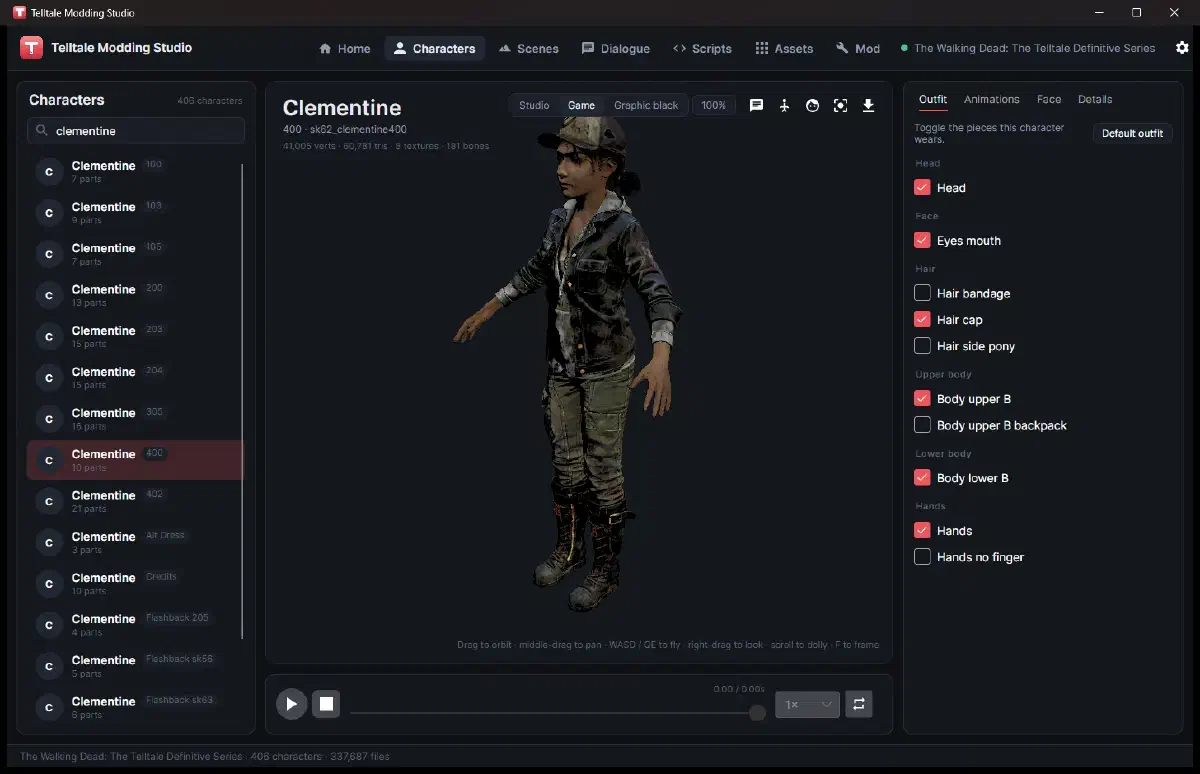
Working on the rewind mod and the mod launcher meant a lot of extracting archives and squinting at hex. I wanted one place to look at a Telltale game the way it actually is: its characters, scenes, dialogue and scripts, not a folder of .d3dmesh files.
Telltale Modding Studio is that place. Point it at an installed game and it indexes everything in a few seconds. It works with The Walking Dead: The Telltale Definitive Series, Season Two, Michonne, Tales from the Borderlands, The Wolf Among Us and Game of Thrones.
Characters#
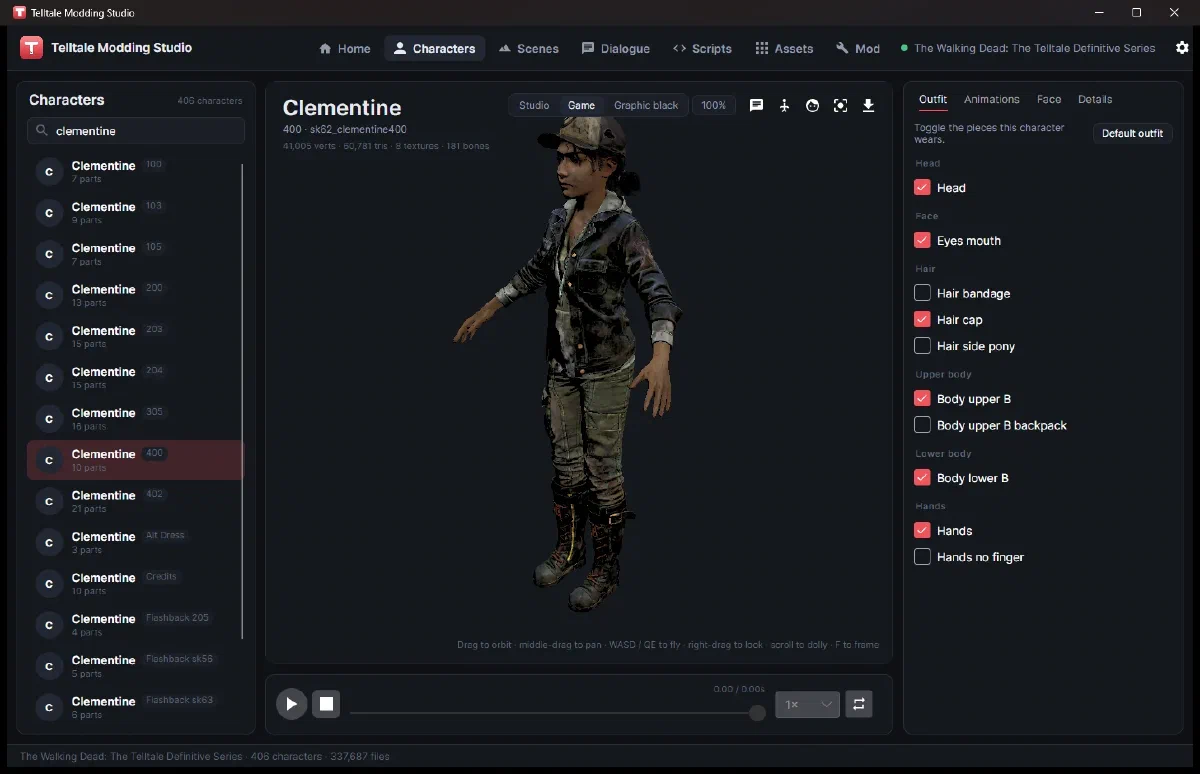
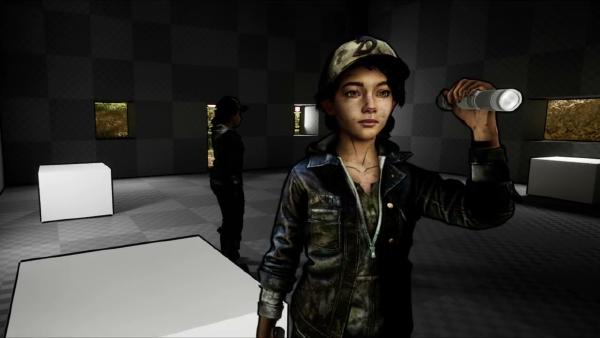
Every character the game defines, dressed the way the game dresses them. The default outfit comes from the character’s own property file, and every other part (hats, damaged heads, alternate jackets) can be switched on in the Outfit tab.
- Pick any clip in the Animations tab and it plays on the model. Skinning runs on the GPU, so even 60,000-triangle characters play smoothly.
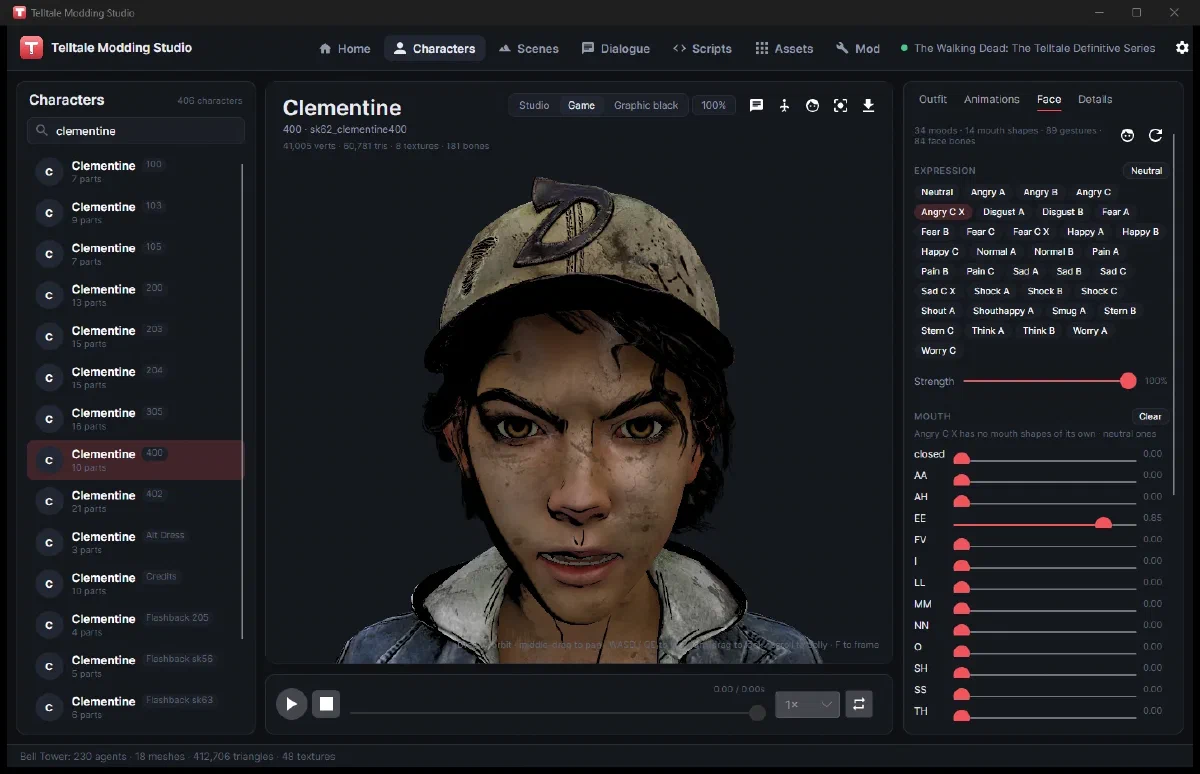
- The Face tab poses the face over the playing clip: a mood’s expression, mouth shapes, gestures and single facial bones.
- A skeleton toggle draws the bones inside the model.
- Export saves the dressed, textured character with its skeleton and the playing clip as a
.glbfor Blender.
Looking like the game#
Each game has its own look, so I read the games’ compiled shaders and rebuilt them: Tales from the Borderlands’ black outlines and hand-drawn line art, The Wolf Among Us’ banded toon lighting, the Definitive Series’ ink textures and graphic black. A switch at the top picks Studio lighting for inspecting textures, the game’s own look, or Graphic black, which adds the Definitive Series’ solid black shadows to any game.
Dialogue#
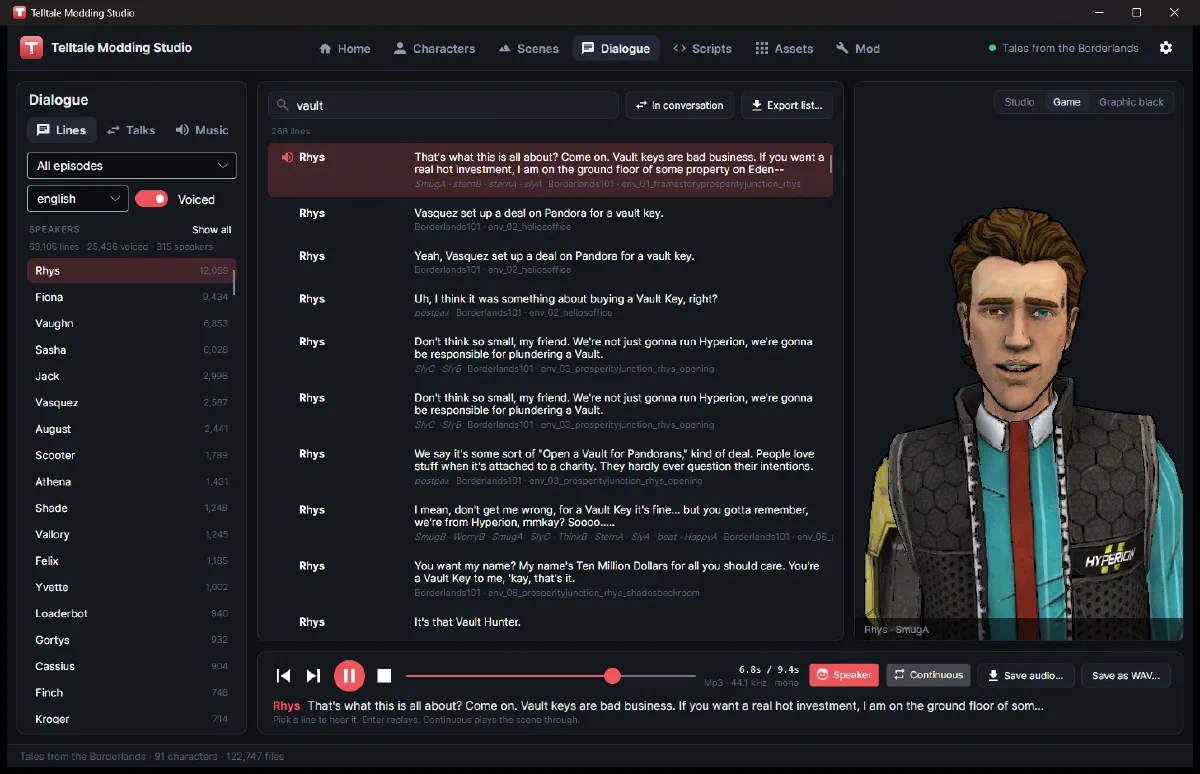
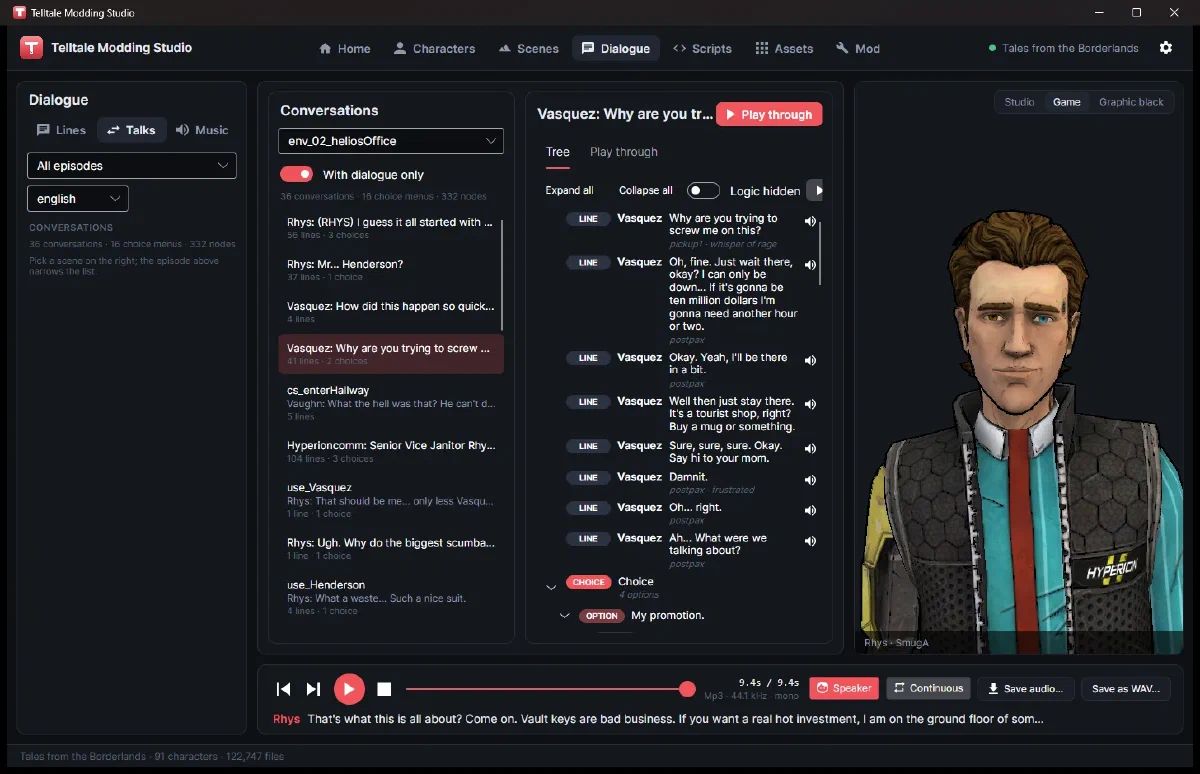
Every subtitle line in the game, matched to its voice recording. Click a line and you hear it while the character says it in 3D beside the list. Every voice line has a phoneme track, and the app drives the character’s mouth shapes from it, in the mood the line’s direction tags name.
The voice files are FMOD sound banks. The Vorbis ones leave out the codec setup the decoder needs, so the app reads it out of the FMOD library each game installs.
Conversations#
Talks shows a scene’s conversations as the game’s own dialogue tree: lines, choice menus and their options, branches and jumps. You can play a conversation through and pick the choices as buttons. The Music tab lists each game’s soundtrack.
Scenes and scripts#
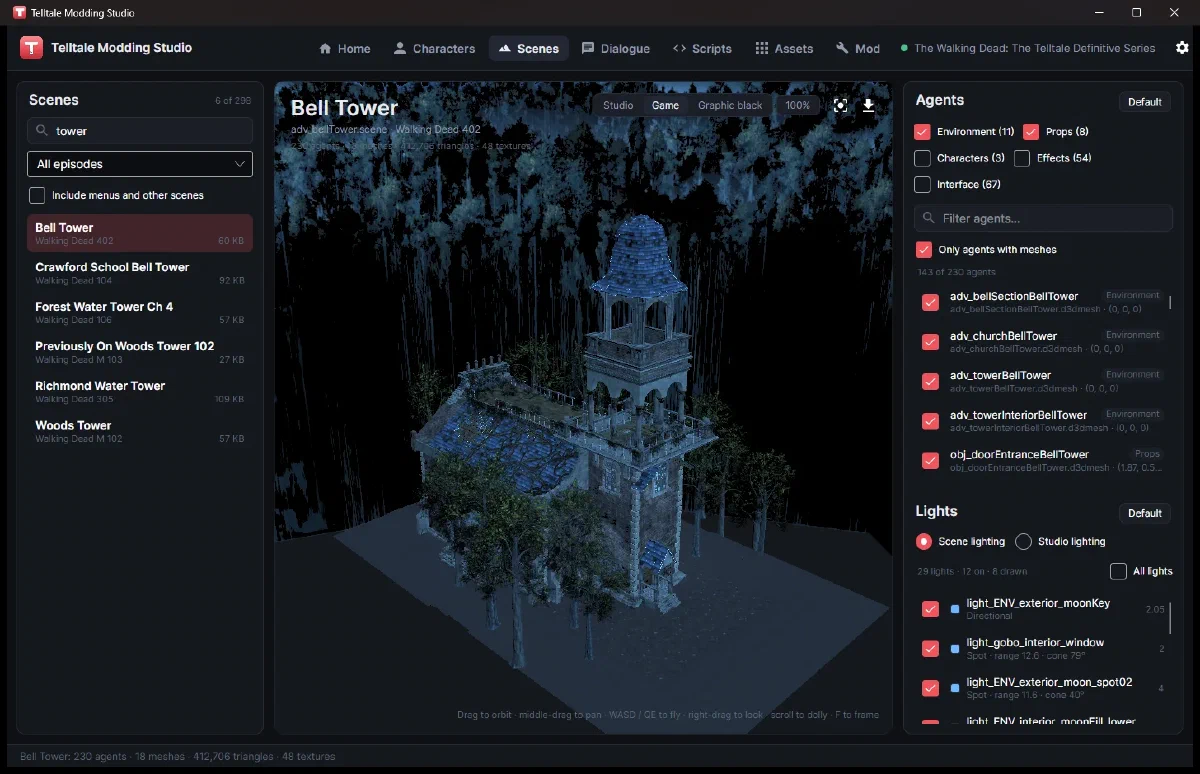
Scenes are rebuilt from their .scene files: every object placed and textured, lit by the scene’s own lights. Orbit around, or click the view and fly with WASD.
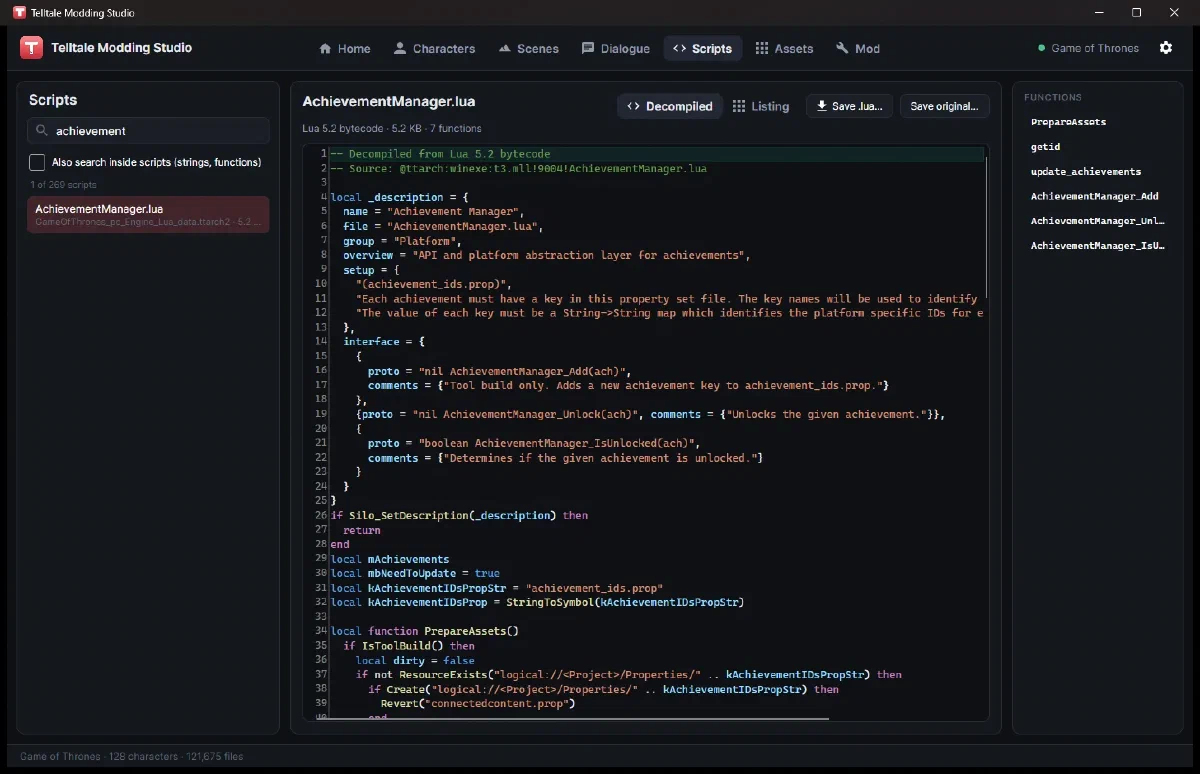
The game logic is Lua, shipped as compiled bytecode. The app decompiles it back to readable source, with a function outline and search. It handles Lua 5.2 and the older games’ Lua 5.1, including the shuffled opcode numbers some of them use.
Getting it right#
Showing a character takes a lot of guessing about which mesh, texture and material go together, so I checked every character and outfit in all six games and fixed what came up. A few of the more interesting ones:
Nods that don't nod
Bigby's head nods were frozen. They weren't misread: The Wolf Among Us' later episodes and patches carry re-exports of many episode 1 clips with all but the first frame cut. The app plays the original when the winning copy doesn't move, which brought 110 clips back.
Materials that stopped early
A material is a list of typed properties with no sizes, so one unknown type meant everything after it was lost. The reader now knows the layouts it meets and steps over the ones it doesn't. All 114,637 materials in the Definitive Series read completely.
Inherited textures
Some zombies' hands and feet name no texture of their own; they inherit it from a parent material. Without reading the parent they came out solid black.
Heads picked by script
Some Game of Thrones soldiers turn every head off in their data and let a script pick one at spawn, which left their eyes floating. They now get a default head and hair.
Files and mods#
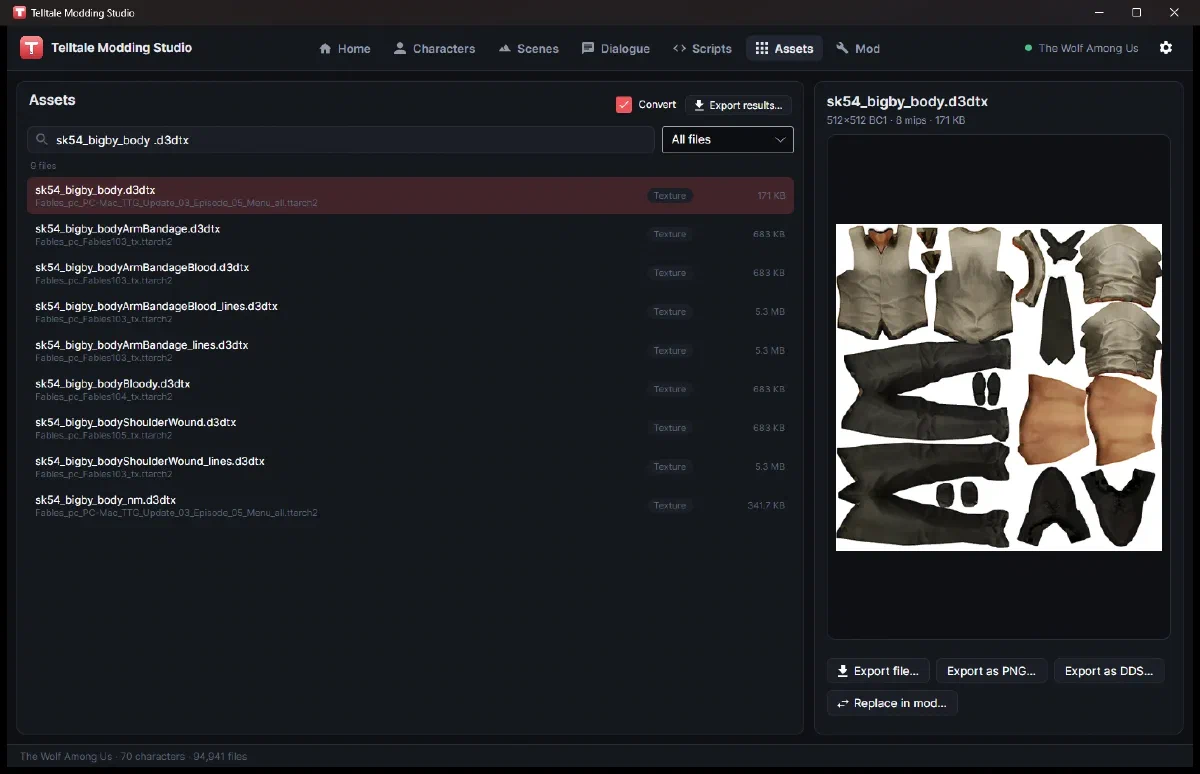
Assets searches every file in the game, previews textures, models and sounds, and exports them as everyday formats: PNG, WAV, MP3 or Ogg, decompiled Lua, subtitle transcripts. Mod lets you swap any file for your own and builds a small patch archive the game loads over its originals, the same way Telltale shipped its own patches.
The .ttarch2 archives are read natively: a port of the archives’ Blowfish variant, zlib, and the Oodle library each game ships.
Getting it#
The 1.0.0 release is a self-contained Windows zip: unzip it and run TelltaleModding.App.exe. It’s .NET 8 and Avalonia. Everything in it belongs to Telltale Games and the games’ licensors; the app only reads the games you have installed.